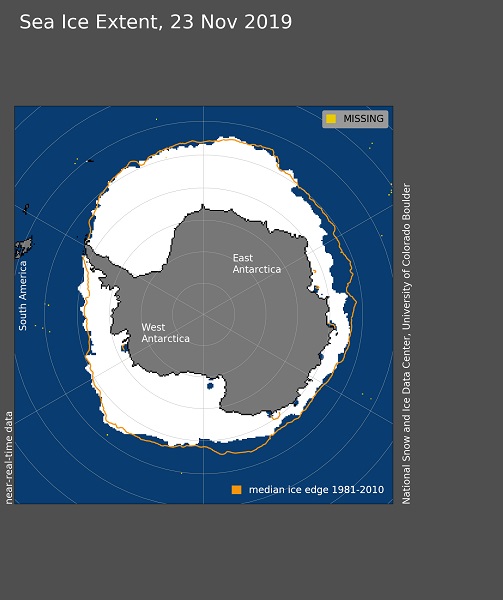
November 23th, 2019: Antarctic sea ice extent ***********************
October daily sea ice extent went from third lowest in the satellite record at the beginning of the month to lowest on record starting on October 13 through October 30. Daily extent finished second lowest, just above 2016, at month’s end. Average sea ice extent for the month was the lowest on record. While freeze-up has been rapid along the coastal seas of Siberia, extensive open water remains in the Chukchi and Beaufort Seas, resulting in unusually high air temperatures in the region. Extent also remains low in Baffin Bay.
Arctic sea ice extent averaged for October 2019 was 5.66 million square kilometers (2.19 million square miles), the lowest in the 41-year continuous satellite record. This was 230,000 square kilometers (88,800 square miles) below that observed in 2012—the previous record low for the month—and 2.69 million square kilometers (1.04 million square miles) below the 1981 to 2010 average. Daily ice extent began tracking below 2012 levels on October 13 and continued to do so through the end of the month, which was enough to reach a new record monthly low at 5.66 million square kilometers (2.19 million square miles). The Arctic gained only 2.79 million square kilometers (1.08 million square miles) of ice in October 2019, compared to 3.81 million square kilometers (1.47 million square miles) in October 2012.
Autumn freeze-up was slow during the first half of October, with most of the increases in the eastern Beaufort Sea and Laptev Sea. During the second half of the month, ice began to grow quickly along the coastal regions of the East Siberian and Laptev Seas. Sea ice also began forming around northern to north-eastern Svalbard. Overall, the ice edge remained considerably north of its average location throughout the Beaufort, Chukchi, Kara, and Barents Seas, as well as within Baffin Bay. However, around Svalbard, the sea ice has returned to near average conditions for this time of year. As of October 15, the ice extent in the Chukchi Sea is the lowest on record for this time of year.
Image courtesy of the National Snow and Ice Data Center, University of Colorado, Boulder (https://nsidc.org/arcticseaicenews/). Data source see http://nsidc.org/arcticseaicenews/about-the-data/