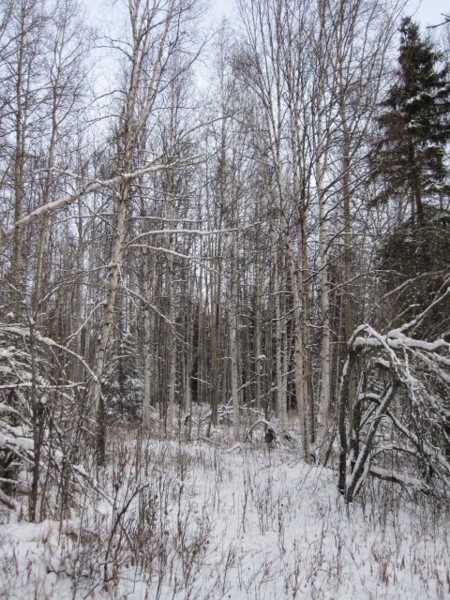
It was mid day and -8.5 C when I
took these photos. It is hard to see but a light snow was falling. We had
received about 20 mm of fresh snow overnight and when I measured the depth
of the entire snowpack (in three places of undistrubed snow near my study
plot) it was an average of 165 mm. I also took a s sample of snow to
determine the rain equivalent (or liquid amount) and took it inside to
melt. Later in the day I measured this as 15.6 mm of liquid water. When
expressed as a percent of the depth of snow (depth of solid water to depth
of liquid water) this calculation is 9.45%. That is lower than, but close
to, the standard 10:1 ratio commonly accepted by meteorologists. That is,
10 inches of snow is about the same as 1 inch of rain (or in places other
than the US: 100 mm of snow is the same as 10 mm of rain.)
I also collected snow to melt and test for pH, which was 5.5. We have
noticed since late summer that the birch trees in our area produced a lot
of seeds. They are everywhere! (Including inside my house - they are very
hard to clean off shoes/ boots before coming inside!) I wonder how much the
large number of seeds I found in the snow I collected impacted the pH
reading. It would be interesting to collect some snow, carefully, to
exclude any birch seeds, to compare. I will try to remember to do that next
time.
On the day I collected this data and took the photos, 3 November, the sun
rose at 9.46 am and set at 5.25 pm, for a total of 7 hours and 38 minutes of
daylight. This was the last day of Daylight Savings for 2012. The month of
November sees a dramatic change in our day length. By the end of the month
we will lose about 3 hours in the length of the day!